
Imagine you’re on a late-night arbitrage hunt: a new liquidity pool on Arbitrum shows a fleeting price dislocation, and a quick swap could be profitable. You’ve connected your browser wallet, hit the dApp’s “swap” button, and a signing request pops up. Do you sign immediately because you trust the UI, or do you pause and inspect? That pause is where Rabby’s transaction simulation and pre-transaction risk scanning aim to change behavior for the better.
This article walks through the mechanics of Rabby’s browser extension—how simulation works, what it catches (and what it doesn’t), and how to treat its signals when you’re operating at scale in the U.S. DeFi market. I’ll use a realistic case to illuminate the trade-offs and end with decision heuristics you can reuse when evaluating wallets that promise “safety by simulation.”
Case: An Arbitrum Swap with a Hidden Approval
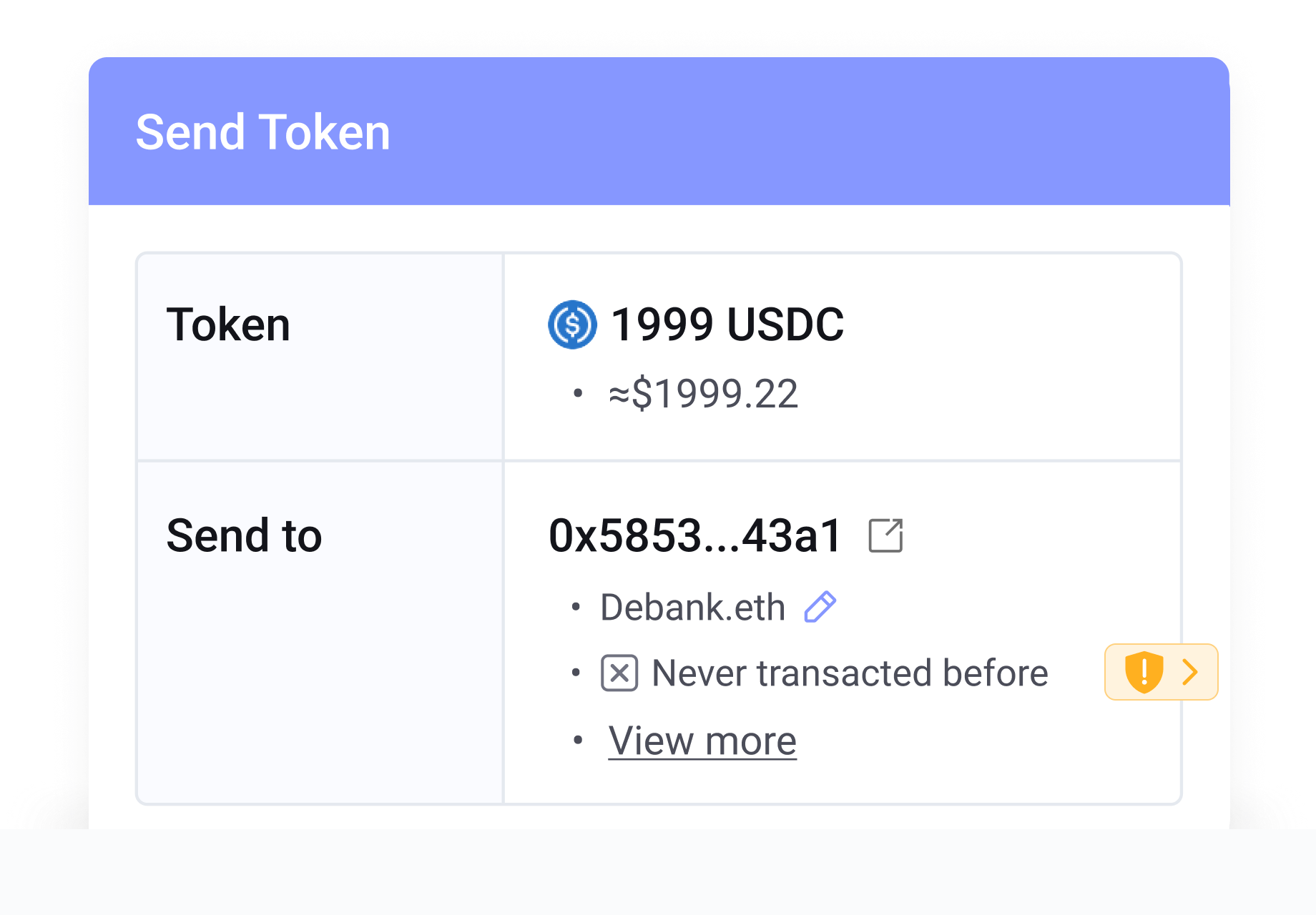
Consider this scenario: you intend to swap 10,000 USDC on Arbitrum for an illiquid governance token. The dApp first sends an approval request, followed by the swap transaction. Many wallets present the approval and rely on your judgment; others, like Rabby, simulate the approval and swap before you sign. The simulation shows how balances will change, what gas will cost, and whether the approval is infinite or limited. Crucially, Rabby’s pre-transaction scanner can flag the target contract if it’s been involved in previous breaches or is newly created with no on-chain history.
Mechanically, simulation recreates the transaction against a local or remote node to estimate state changes without broadcasting. It’s not a mathematical proof—it’s a deterministic replay under current chain state. That allows Rabby to display token deltas and fee estimates and to detect anomalies such as a transfer to a suspicious address or an approval with no expiry. This is how Rabby differentiates from MetaMask and other mainstream wallets: the interface reduces “blind signing” by converting abstract calldata into human-readable effects.
How Transaction Simulation Changes the Threat Model
Traditional browser wallets ask users to sign hex-encoded calldata. That’s a brittle UX: most users cannot parse calldata, and many rely on trusting the dApp. Simulation shifts risk assessment earlier and gives measurable signals. For a DeFi power user, those signals matter because they often perform many interactions where a single erroneous approval can expose large balances.
But what does simulation actually stop? It prevents straightforward blind signing errors: approving infinite allowances accidentally, approving tokens to malicious contracts that immediately drain balances, or signing transactions with unexpectedly large fees. Rabby’s engine also runs checks for known compromised contracts and non-existent recipient addresses, and it offers native approval revocation so you can undo excessive permissions after the fact.
Limits and Failure Modes: What Simulation Cannot Do
Simulation is powerful but not omnipotent. First, it is only as accurate as the node state and the contract code it simulates against. If a contract’s behavior depends on off-chain data (an oracle that will change after your simulation) or time-dependent logic, the simulated result may differ from the outcome when mined. Second, zero-day exploits or vulnerabilities in a contract’s logic could be invisible to static heuristic scanners; a past exploit flag only helps if the exploit is already known. Third, simulation cannot prevent social-engineering attacks where you intentionally approve an operation you later regret; the tool changes the information available, not your incentives.
Rabby’s past incident—a 2022 smart contract exploit affecting a swap contract—illustrates these limits. The development team froze the contract, reimbursed users, and hardened audits afterward. That response shows responsible operations, but it also highlights a systemic truth: wallet-level protections reduce, but do not eliminate, smart-contract risk.
Trade-offs: Convenience, Security, and Composability
Rabby aims to balance usability and safety. Two features highlight this balancing act. First, automatic network switching streamlines UX: visiting a dApp on Polygon triggers Rabby to switch networks for you. That reduces friction for multi-chain power users but introduces an attack surface if a malicious site tricks the wallet into switching chains and prompting an unfamiliar transaction. Second, cross-chain gas top-up is a convenience—send ETH or BNB to a chain where you lack gas—but it increases operational complexity and the risk of user mistakes when selecting destination chains.
Integration with institutional tools (Gnosis Safe, Fireblocks) and hardware wallets (Ledger, Trezor, Keystone, and others) shifts Rabby toward professional-grade use. Those integrations are essential for users who cannot accept a single-device private key risk. Still, adding compatibility layers can create integration bugs, so rigorous audit trails and multi-sig controls remain necessary.
Decision-Useful Framework: When to Trust a Simulation
Use this quick heuristic when Rabby (or any simulation-enabled wallet) flags a transaction:
- If the simulation shows unexpected token deltas or infinite approvals, pause and set the approval to a precise, limited amount.
- If the scanner flags a contract with prior breaches or a zero-history contract, treat the transaction as high-risk and require secondary confirmation (hardware wallet + manual contract review).
- If the transaction depends on external state (oracle-fed price, time-locked functions), assume simulation is provisional and either simulate immediately before sending or require smaller test trades.
Another practical rule: use simulated approvals and then immediately visit the built-in revocation tool to confirm only necessary permissions remain. That two-step habit reduces exposure and is uniquely supported by Rabby’s integrated tooling.
Comparative Perspective and Where Rabby Fits
Compared with MetaMask, Trust Wallet, and Coinbase Wallet, Rabby’s explicit value proposition is security-by-simulation plus convenience features like automatic network switching. For U.S.-based DeFi traders who need a browser extension that integrates hardware keys, multi-sig, and a revocation dashboard, Rabby presents a pragmatic middle ground: more security signals than a basic wallet, fewer institutional controls out-of-the-box than a full custodial suite.
Because Rabby is open-source under MIT, independent audits and community scrutiny are possible; that transparency matters for trust in the absence of a regulator-backed guarantee. But open-source alone is not a substitute for formal verification: audits and operational hygiene must continue to be prioritized.
What to Watch Next
For practitioners and security teams, monitor three signals over the next 12–24 months: (1) adoption of transaction simulation by other major wallets (which would standardize expectations and raise the bar), (2) frequency and severity of contract-level exploits despite simulations (which would signal simulator blind spots), and (3) improvements in simulation fidelity for time- and oracle-dependent contracts. Any of these trends would materially change how much weight to place on a simulation result when trading at scale.
If regulators in the U.S. increase scrutiny on consumer-wallet disclosures or on custodial services, wallets that offer rich pre-transaction information and explicit risk warnings may be better positioned legally and commercially. That’s a conditional scenario: if transparency becomes a compliance baseline, simulation will be both a competitive feature and a risk-mitigation requirement.
Where to Try It and Practical Next Steps
If you want to evaluate Rabby hands-on, install the Chrome-compatible browser extension and pair it with a hardware wallet for testing. Use small test amounts on a secondary account and exercise approval, swap, and revocation flows. The integrated portfolio view is useful for cross-chain tracking, but remember Rabby does not currently include a fiat on-ramp or native staking features—so plan your flows accordingly. For more about the wallet and installation details, see this resource on the official page for rabby wallet.
FAQ
How reliable are Rabby’s transaction simulations?
Simulations are reliable within the constraints of on-chain state at the time of simulation and the contract’s deterministic behavior. They are effective at exposing blind signing issues (like unexpected approvals or fee surprises) but can be inaccurate for contracts that depend on future oracle data, off-chain calls, or time-sensitive conditions. Treat simulation as strong evidence, not proof.
Can Rabby prevent all smart-contract exploits?
No. Rabby reduces risk by flagging known bad contracts, showing exact token deltas, and letting users revoke approvals, but it cannot prevent unknown vulnerabilities in third-party contracts or sophisticated attacks that exploit protocol logic rather than simple approval mistakes.
Is Rabby suitable for institutional use?
Rabby integrates with multi-sig and institutional custody solutions (Gnosis Safe, Fireblocks, Amber, Cobo), and supports hardware wallets—features important for institutional workflows. Institutions should still layer policies, operational controls, and routine audits on top of the wallet for production use.
Does Rabby work on all chains and platforms?
Rabby supports over 90 EVM-compatible chains and is available as a Chromium-based browser extension, mobile apps, and desktop clients. It also integrates with many hardware wallets. That breadth is useful for multi-chain users but increases the need for careful chain selection and verification when performing cross-chain actions.
Deprecated: Function get_magic_quotes_gpc() is deprecated in /home/aslgroupcom/programusahawan.com/pembayaran/wp-includes/formatting.php on line 4387
Deprecated: Function get_magic_quotes_gpc() is deprecated in /home/aslgroupcom/programusahawan.com/pembayaran/wp-includes/formatting.php on line 4387
Deprecated: Function get_magic_quotes_gpc() is deprecated in /home/aslgroupcom/programusahawan.com/pembayaran/wp-includes/formatting.php on line 4387